No woman should be forced to remain in a marriage that has become a source of emotional pain, humiliation, fear, or mental suffering.
If you are considering Khula in Pakistan, it is important to know that Pakistani law fully recognizes a woman’s independent legal right to seek dissolution of marriage through the Family Court even without the consent of her husband.
Many women silently endure emotional neglect, psychological pressure, toxic marital environments, abandonment, financial dependency, and continuous uncertainty about their future. Pakistani family law exists to ensure that every woman has access to legal protection, dignity, justice, and the right to move forward peacefully and lawfully.
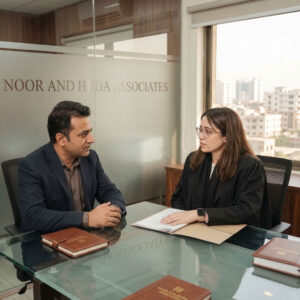
At Noor & Huda Associates – Advocates & Legal Consultants, Advocate Noor Ul Huda Chaddhar regularly represents women in Khula cases across Pakistan and for Overseas Pakistanis worldwide. With extensive experience in Pakistani family law and Family Court litigation, she provides complete legal assistance from filing the Khula petition to obtaining the final NADRA Divorce Certificate.
1. WHAT IS KHULA?
The word Khula comes from the Arabic verb meaning to “remove or to take off”, rooted in the Quranic description of spouses as garments for one another. In Pakistani law, Khula is a wife’s right to seek the judicial dissolution of her marriage through the Family Court, returning to herself the freedom and dignity that marriage is meant to protect.
Khula in Pakistan is not just a religious concept. It is a full and enforceable judicial right, actionable before the Family Court under the West Pakistan Family Courts Act 1964 and supported by the highest levels of Pakistan’s legal and constitutional framework.
If you are searching for a Khula lawyer in Lahore, a female family lawyer in Pakistan, or need to understand how to get Khula without your husband’s consent, the specialist female family lawyers at Noor and Huda Associates have helped hundreds of women across Pakistan and internationally exercise this right with confidence, clarity, and complete legal protection.
2. The Four Legal Pillars of Khula in Pakistan
Your right to Khula in Pakistan rests on four unshakeable legal pillars that Noor and Huda Associates invokes strategically in every Khula petition filed on your behalf.
The Holy Quran | Surah Al Baqarah 2:229
This is the divine source of Khula in Islam, establishing that a wife may seek release from her marriage with dignity and without compulsion. This principle is recognised across all four major schools of Islamic jurisprudence, including Hanafi, Maliki, Shafii, and Hanbali. For women asking whether Khula is valid in Islam or allowed in Pakistan, this Quranic authority provides the definitive answer.
The Muslim Family Laws Ordinance 1961
This is Pakistan’s primary legislative framework governing matrimonial rights. The Muslim Family Laws Ordinance 1961 ensures that a wife’s right to dissolve her marriage in Pakistan is protected by statute and fully enforceable through formal legal process.
The West Pakistan Family Courts Act 1964
This is the procedural backbone of every Khula case in Pakistan. This Act empowers the Family Court across Pakistan to hear, decide, and decree Khula petitions, giving women direct and accessible judicial recourse without needing the husband’s consent or cooperation.
The Dissolution of Muslim Marriages Act 1939
This is the foundational legislation defining the specific grounds upon which a wife may seek court ordered dissolution of marriage in Pakistan. These grounds include cruelty under Pakistani family law, mental abuse, desertion, failure to provide maintenance, and imprisonment. For women experiencing domestic violence, psychological abuse, or a husband’s second marriage without consent, this law provides powerful additional grounds.
3. KHULA VS. OTHER FORMS OF DIVORCE
Pakistani family law recognizes five principal forms of marital dissolution, each differing in who initiates the process and whether court involvement is required.
| Type | Initiated By | Court Involvement |
|---|---|---|
| Khula | Wife | Yes, Family Court |
| Talaq | Husband | No, Union Council |
| Mubarat | Both (mutual consent) | No, Union Council |
| Faskh | Wife | Yes, Family Court |
| Tafweez | Wife (delegated right) | No, Union Council |
4.Documents Required for Khula in Pakistan
If Nikahnama is Not Available
Don’t you have Nikahnama? No problem!
5. STEP-BY-STEP KHULA PROCEDURE
| Step | Title | Description |
|---|---|---|
| 1 | Engage Specialist Legal Counsel | Khula is a judicial proceeding navigating multiple legal systems. It is important to engage top male or female advocates with specialist family law expertise. |
| 2 | Prepare and File the Khula Petition | The petition is filed before the competent Family Court. Family Courts must conduct reconciliation in good faith but must not use proceedings to delay or frustrate the case. |
| 3 | Service of Notice on Defendant (Husband) | The Family Court issues formal notice to the husband informing him of the proceedings. |
| 4 | Mandatory Reconciliation Proceedings | Under section 7 of the Family Courts Act 1964, the court must first attempt reconciliation. If reconciliation fails, the case proceeds further. |
| 5 | Recording of Evidence and Trial | The petitioner presents evidence, including oral testimony and documents. The court evaluates all evidence and grants Khula if genuine aversion is established. |
| 6 | Determination of Zar e Khula (Mehr Return) | The court decides whether the wife must return any Mehr. This depends on judicial discretion and the conduct of both parties. |
| 7 | Union Council Registration (90 Days Procedure) | The Khula decree is sent to the Union Council. A mandatory 90 days period is observed under MFLO 1961, after which dissolution becomes effective. |
| 8 | NADRA Divorce Certificate | The Union Council issues the dissolution certificate and NADRA updates marital status to divorced and issues the official certificate. |
Noor Ul Huda Chaddhar – Top Female Khula & Family Lawyer in Lahore 2026
Advocate Noor Ul Huda Chaddhar is the Founder and Principal Family Lawyer of Noor & Huda Associates and one of Pakistan’s leading female family law practitioners, with over 10 years of dedicated experience in Khula, divorce, child custody, maintenance, and family dispute resolution. She has successfully represented hundreds of clients in Pakistan and internationally, including overseas Pakistanis in the UK, UAE, Canada, USA, Australia, and Saudi Arabia, securing Khula decrees, protecting financial rights, and enforcing child custody matters through strategic and result-oriented litigation. Known for her strong courtroom advocacy, compassionate approach, and client-focused legal strategy, she provides complete end-to-end legal services from filing of Khula petitions to final decree and NADRA documentation, including remote representation through Special Power of Attorney for clients abroad. Noor Ul Huda Chaddhar is widely recognized for delivering transparent, confidential, and effective legal solutions, ensuring every client receives personalized attention and strong legal representation in accordance with Pakistani family law.
| ⚖ JUDGMENT |
|---|
| SUPREME COURT • October 2025 – Landmark • Justice Ayesha Malik Judgment |
| Psychological and emotional abuse, threats, controlling behaviour, financial coercion, social isolation, mental torment constitutes ‘cruelty’ under DMMA 1939. Courts must not require physical violence as a precondition. Stigmatising language in judgments (‘disobedient wife’) violates Article 14 (dignity) of the Constitution. Binding on all Family Courts across Pakistan. Noor & Huda Associates applies this landmark ruling to support all clients experiencing psychological or emotional abuse, ensuring courts recognize the full spectrum of harm. |
| ⚖ JUDGMENT |
|---|
| SUPREME COURT OF PAKISTAN • PLD 1963 SC 51 • Syed Ali Nawaz Gardezi v Lt.-Col. Muhammad Yusuf |
| This is a landmark Supreme Court of Pakistan case detailing divorce laws, the effectiveness of divorce (talaq), that a divorce (talaq) becomes effective only after 90 days have passed following notice to the Chairman, and the custodial rights of a mother over a minor. Our advocates invoke this authority to enforce every financial entitlement owed to you, regardless of any contrary custom or resistance from the husband’s side. |
| ⚖ JUDGMENT |
|---|
| SUPREME COURT OF PAKISTAN • PLD 1967 SC 97 — FOUNDATIONAL • Mst. Khurshid Bibi v Muhammad Amin |
| Khula is an inalienable fundamental right of a Muslim wife. The husband’s consent is NOT a legal prerequisite. Where the wife sincerely establishes genuine aversion, the Family Court is duty-bound to grant dissolution. Noor & Huda Associates builds every Khula petition around this foundational authority to ensure your case rests on the strongest possible legal footing. |
A: Absolutely and unconditionally. This was settled definitively by the Supreme Court of Pakistan and has been consistently upheld in hundreds of judgments across every tier of the Pakistani judiciary. The husband’s consent is entirely irrelevant. If the wife sincerely establishes genuine aversion to the continuation of the marriage, the court is duty bound to grant Khula.
A: Khula is the wife’s judicial right to seek dissolution of marriage before a Family Court, no husband’s consent required. It originates from the Holy Quran (Surah Al-Baqarah 2:229) and is governed by the West Pakistan Family Courts Act 1964 and the Muslim Family Laws Ordinance 1961. Talaq, by contrast, is the husband’s unilateral right to pronounce divorce, no court involvement, no grounds required processed through the Union Council.
A: Genuine and sincere hatred to the continuation of the marriage. This is the only legal standard required by Pakistani courts.
A: Yes, Khula is explicitly sanctioned by the Holy Quran (Surah Al-Baqarah 2:229), the authentic Hadith of the Prophet Muhammad (PBUH), and is unanimously recognised by all four major schools of Islamic jurisprudence: Hanafi, Maliki, Shafi’i, and Hanbali. There is absolutely no basis in Islamic law for treating Khula as religiously invalid or socially shameful.
A: Both are forms of court ordered dissolution initiated by the wife. The key difference lies in the standard of proof. Khula requires only ‘genuine aversion’ no specific misconduct needs to be proved. Faskh under Section 2 of the Dissolution of Muslim Marriages Act 1939 requires the wife to prove one or more of nine specific statutory grounds such as the husband’s disappearance for four years, failure to maintain for two years, imprisonment for seven or more years, or cruelty.
A: The Family Court judge performs several critical functions: (1) assesses the genuineness and sincerity of the wife’s expressed aversion a factual inquiry; (2) conducts or supervises mandatory reconciliation proceedings under s.7 of the Family Courts Act 1964; (3) records evidence from both parties, or proceeds ex parte if the husband fails to appear; (4) determines the question of Zar-e-Khula — whether any portion of Mehr must be returned; (5) passes the decree of dissolution by Khula; and (6) makes ancillary orders for custody, maintenance, and dowry recovery if sought in the same petition.
A: Mehr (dower) is the agreed sum or property payable by the husband to the wife under the Nikah Nama. In Khula, the question of whether the wife must return any portion of her Mehr called Zar-e-Khula is entirely at the court’s discretion. It is NOT a mandatory precondition for dissolution. Where the breakdown of the marriage is attributable to the husband’s misconduct cruelty, failure to maintain, addiction, second marriage without consent, desertion courts consistently waive or significantly reduce Zar-e-Khula.
A: Your dowry (Jahez) is your absolute and unconditional personal property under both Islamic law and Pakistani statutory law. It belongs to you permanently and irrevocably. No court can order you to return Jahez, and no husband can claim it back under any circumstances, whether in Khula or any other form of dissolution.
A: Yes. You can apply for interim maintenance from the very date of filing your Khula petition. Under the West Pakistan Family Courts Act 1964, the Family Court has explicit power to order the husband to pay interim maintenance (nafaqa) pending final disposal of the case. This is critically important because Khula proceedings may take several months. You should not be compelled to go without financial support during that period. Noor & Huda Associates routinely applies for and obtains interim maintenance orders early in the proceedings to protect clients’ financial position.
A: The Iddat period after Khula is three complete menstrual cycles (approximately 90 days) for a non-pregnant woman, or until delivery if pregnant. During this period: (1) The husband MUST pay full maintenance (nafaqa) this is an absolute Islamic and statutory obligation with no exceptions; (2) You may not remarry or contract a fresh Nikah; (3) You must not conceal a pregnancy; (4) The husband has no right to re enter the matrimonial home. After Iddat expires, you are fully and unconditionally free to remarry.
A: Under traditional Pakistani family law, the wife’s right to her husband’s maintenance generally ends upon expiry of Iddat. However, you may still claim: (1) full unpaid deferred Mehr (Muwajjal), which becomes immediately due upon dissolution; (2) recovery of dowry (Jahez) in full; (3) child maintenance, which is a separate and ongoing obligation of the father. A landmark 2021 Federal Shariat Court ruling directed courts to consider extended maintenance in hardship circumstances. Noor & Huda Associates advises each client on the maximum financial entitlements available in their specific circumstances.
A: Yes, absolutely. If your Mehr was deferred (Muwajjal Mehr), it becomes immediately due and payable upon the date of the Khula decree.
A: Yes. A court decree for maintenance or Mehr can be executed against any property or assets of the husband that come to light at any time including property held in a third party’s name if transferred to defeat the decree.
A: Custody (Hizanat) in Pakistani law is governed by the welfare of the child as the paramount and overriding consideration. As a working guide: mothers have presumptive Hizanat over sons until age 7 and over daughters until puberty.
A: No, not without a court order granting him custody.
A: Act immediately, do not wait. File urgently for: (1) an emergency interim custody order; (2) an injunction restraining the husband from removing the children from Pakistan; (3) an application to impound or deposit the children’s passports with the court. Contact Noor & Huda Associates immediately delay in these matters can have irreversible consequences for custody.
A: Yes, the father’s obligation to financially maintain his children is absolute under Islamic law and Pakistani statute.
A: Yes, and this is precisely what Noor & Huda Associates recommends.
A: No, if a mother who remarries, will not lose custody.
A: Yes, absolutely. Noor & Huda Associates regularly handles Khula for clients resident in the UK, UAE, Canada, USA, Australia, Saudi Arabia, Qatar, Germany, Norway, Sweden, and across the world. You can execute a Special Power of Attorney (SPA) which act as your fully empowered legal representatives in all Pakistani proceedings.
A: An SPA is a formal legal instrument by which you can appoint Noor & Huda Associates as your fully authorised legal representative in all Pakistani Khula proceedings.
A: The Family Court in the district where: (a) the husband is currently residing in Pakistan; (b) the marriage was solemnised; or (c) the parties last resided together in Pakistan any of these courts will have jurisdiction to hear your Khula petition. Noor & Huda Associates assesses all three jurisdictional options and files in the court that will be most efficient and advantageous for your specific case.
A: Your immediate options are: (1) File for Khula in Pakistan (2) Simultaneously file for divorce under the law of your country of residence where applicable; (3) File for child maintenance through the Pakistani Family Court against the husband’s Pakistani assets; (4) Report the abandonment to relevant authorities in your country if you need immigration or financial support. We coordinate all Pakistani proceedings completely remotely so you can focus on your immediate circumstances abroad.
A: A Pakistani Khula decree and NADRA Divorce Certificate are generally recognised in the UK as an ‘overseas divorce’ under the Family Law Act 1986. For the UAE, Canada, USA, and EU countries, the apostilled NADRA Divorce Certificate is accepted by immigration authorities, foreign courts, and government departments. Noor & Huda Associates arranges the MOFA apostille in Lahore on your behalf and can courier the certified documents directly to you abroad.
A: Yes, the NADRA Divorce Certificate is the official Government of Pakistan document proving the legal dissolution of your marriage. It is accepted by Pakistani and foreign embassies, immigration authorities (UKVI, IRCC Canada, USCIS USA, UAE immigration), foreign courts, and international registries worldwide. For use in Hague Apostille Convention countries (UK, most EU nations, USA, Canada, Australia), the certificate is apostilled by Pakistan’s Ministry of Foreign Affairs. Noor & Huda Associates manages the entire NADRA certificate and MOFA apostille process on your behalf.
A: If you intend to use your NADRA Divorce Certificate in any country party to the Hague Apostille Convention including the UK, all EU member states, Canada, Australia, USA, and most of Europe then yes, an MOFA Apostille from Pakistan’s Ministry of Foreign Affairs is required. Noor & Huda Associates arranges MOFA Apostilles in Lahore on behalf of you.
A: The realistic timelines based on current court workloads are between 1 month to 3 months.
A: Essential documents: (1) Your original CNIC; (2) Original Nikah Nama or certified true copy from the relevant Union Council.
A: Yes. A certified copy of the Nikah Nama can be obtained from the Union Council where the marriage was originally registered or produced an affidavit on behalf of plaintiff. Noor & Huda Associates handles the documentary verification and procurement process.
A: The NADRA Divorce Certificate is the official Government of Pakistan document that proves the legal dissolution of your marriage. It is issued by NADRA after the Union Council registers the dissolution following the mandatory 90-day reconciliation period. You need it for: (1) Remarriage in Pakistan or abroad; (2) Updating your CNIC from ‘married’ to ‘divorced’; (3) All visa and immigration applications UK, UAE, Canada, USA, Australia; (4) Use before any Pakistani or foreign court, government department, or institution.
A: Once you have the NADRA Divorce Certificate, you can update your CNIC at: (a) any NADRA office in Pakistan in person; or (b) the Pakistani Embassy or High Commission in your country of residence NADRA facilities are available at most major Pakistani diplomatic missions worldwide.
A: Yes. Section 7 of the West Pakistan Family Courts Act 1964 mandates that the court must first attempt reconciliation between the parties before proceeding to dissolution.
A: Yes, you can absolutely remarry but first you must legally complete through the Union Council 90-day process after taking Khula decree from the court.
A: No, the Khula decree is non appealable.
A: Yes, an ex parte decree is fully valid and legally complete.
A: Yes, and this has been conclusively settled by the Supreme Court’s landmark judgment of 25 October 2025 (Justice Ayesha Malik).
A: Yes. A husband’s imprisonment for a serious criminal offence is itself an accepted ground for Khula on the basis of genuine aversion a wife.
A: Yes. If the husband cannot be located despite due inquiry, the court can authorise service of notice through alternative means including publication of the Khula notice in a national newspaper such as Dawn or Jang etc. Once the notice period has expired without the husband appearing, the court proceeds ex parte (in his absence).
A: Yes, and it is one of the strongest grounds available. You can also file complaint against him.
A: Yes. A Khula petition may be filed at any time, including during pregnancy.
A: Yes. Failure to register a Nikah under Pakistani law makes the marriage irregular but does not render it void.
A: In February 2026, a five-member bench of the Supreme Court of Pakistan is examining whether a Family Court may grant dissolution on grounds other than those specifically pleaded by the petitioner in the Khula petition. The National Commission on the Status of Women (NCSW) and leading women’s rights advocates have submitted that courts must retain the ability to dissolve marriages on any established ground. Noor & Huda Associates is monitoring these proceedings closely. The current settled law that Khula must be granted upon genuine aversion, without proof of specific misconduct remains fully in force and is unaffected by these pending proceedings.
A: Yes. Noor & Huda Associates provides a full end-to-end overseas Khula service under a Special Power of Attorney.
READY TO FILE FOR KHULA?
Speak to a Specialist Today
NOOR & HUDA ASSOCIATES
Advocates & Legal Consultants
Phone / WhatsApp: +92 300 503 1212 | +92 320 441 2196
Email: info@noorandhudaassociates.com Website: noorandhudaassociates.com
Office No. 2, Mozang, Near Family Hospital, RJ Tower, Lahore.
Serving clients in Pakistan, UK, UAE, Canada, USA, Australia, Saudi Arabia, and worldwide